9 thoughts on “January 12 – 18, 2015 Kaw Valley Almanac”
Without carefully counting, there seem to be fewer eagles below the dam, even with the ice. Still, I see them. I sometimes wonder that we didn’t lose them all together and that the species is flourishing again. One flew almost directly over my head. I took it as a sign – of something : )
There is a certain randomness to how many eagles can be spotted there, tho generally numbers are up when the ice is most widespread, concentrated by the shortage of findable open water. Squaw Creek National Refuge along the Missouri River keeps a semi-regular census and has the following numbers to share in the past month: 12/17:166 12/23:61 12/29:132 1/5:280. Eagle Nature Foundation has been doing a national midwinter census of eagles in the lower 48 and shows that the numbers are up considerably from their first census of 621 eagles in 1961 to over 3700 last year. There is concern that we are witnessing an 8 year decline in the number of immature eagles that make it to their first year, and experts are trying to poinpoint the possible contributors, including West Nile Virus, neonicitonid insecticides and other persistent environmental contaminants. Check out eaglenature.com for more details.
You’re welcome. And don’t forget that a week from this Saturday, Jan. 24, is Eagles Day at Free State High School which includes field trips to look for eagles. The Kaw Council walkabout-talkabout trips are being organized currently and my guess is that next month’s trip will be along the Kaw to look for eagles, too. Check out the schedule when it is posted at https://kawcouncil.wordpress.com/
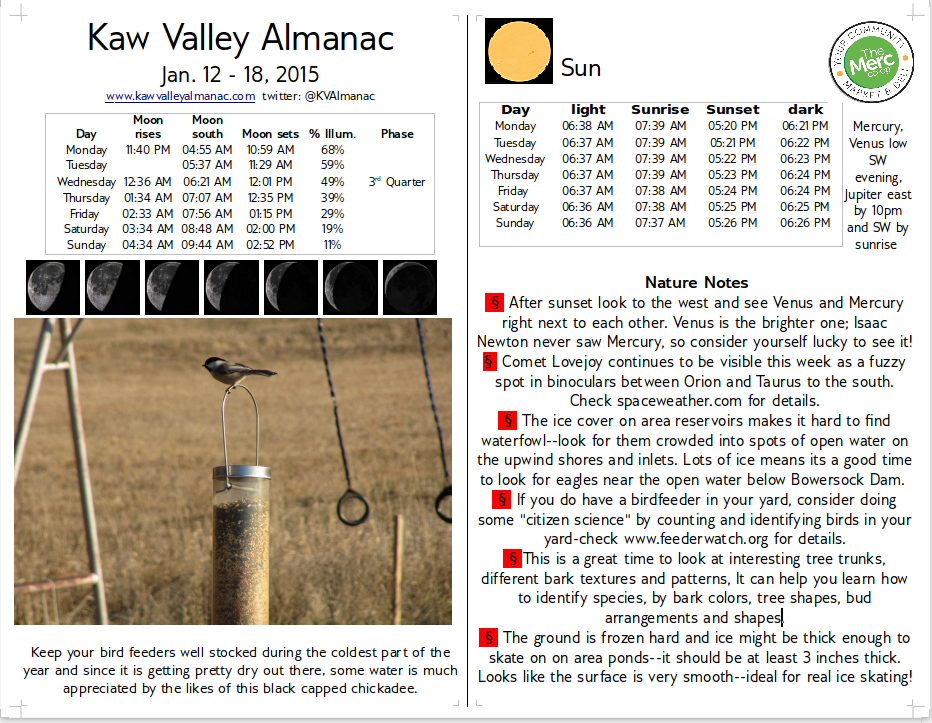
Hi Ken…I’m thinking about being up early in the morning, Friday, to photograph the crescent moon with Saturn to the right of the lower tip. In the chart above, you show Moonrise for Friday being 2:33am, but the time at this link shows 3:34am for January 16. Am I misinterpreting information? Thanks.
Hmmm….I double checked at the tie-breaking site I go to in all such cases, the US Naval Observatory website, and it agrees with the 3:34am moonrise time. I’ve been depending on what I thought was an excellent software program. Cartes du Ciel/SkyChart for my rising and setting times as it provided a very convenient way to download the information into a spreadsheet format, but it seems that the accuracy, once quite good, has drifted. I’ll have to dig deeper and let you know what I found out about that, but in the meantime, 3:34am is the correct time. Hope you get this in time!
Ken
UPDATE: Cartes du Ciel was correct–I just dumped the spreadsheet times one day off this week–the Friday morning date has slipped to Saturday! So sorry, folks; I’ll double check my times from here on out and hopefully won’t make the same mistake again. Thanks, Michael–hope the shot turned out great!
You’re welcome, Ken…I opted to go with the times on the link I sent, got a shot (quite a few shots), but not the shot I hoped to get in part because I misjudged the point where the Moon would first appear. I need a compass that reads true north not magnetic north lol. For where the Moon is actually rising right now, I might have found another more suitable location on my way home. Maybe try again Saturday morning, since I’ll get an hour’s extra sleep lol, even though there will be more separation between the Moon and Saturn. Also, I definitely need to upgrade my lenses, which I knew before but realized how seriously this morning (which might be enough of an excuse to stay in bed! lol). Add a couple thousand to the camera budget this year…oh well lol…
Hey, glad you discovered what happened with the times and that the software is working fine. Thanks for this blog, Ken, very much…
 Kaw Valley Almanac
Without carefully counting, there seem to be fewer eagles below the dam, even with the ice. Still, I see them. I sometimes wonder that we didn’t lose them all together and that the species is flourishing again. One flew almost directly over my head. I took it as a sign – of something : )
LikeLike
There is a certain randomness to how many eagles can be spotted there, tho generally numbers are up when the ice is most widespread, concentrated by the shortage of findable open water. Squaw Creek National Refuge along the Missouri River keeps a semi-regular census and has the following numbers to share in the past month: 12/17:166 12/23:61 12/29:132 1/5:280. Eagle Nature Foundation has been doing a national midwinter census of eagles in the lower 48 and shows that the numbers are up considerably from their first census of 621 eagles in 1961 to over 3700 last year. There is concern that we are witnessing an 8 year decline in the number of immature eagles that make it to their first year, and experts are trying to poinpoint the possible contributors, including West Nile Virus, neonicitonid insecticides and other persistent environmental contaminants. Check out eaglenature.com for more details.
LikeLike
Thanks for the added info. Of course the eagles make decisions on their own that we can only guess at.
LikeLike
You’re welcome. And don’t forget that a week from this Saturday, Jan. 24, is Eagles Day at Free State High School which includes field trips to look for eagles. The Kaw Council walkabout-talkabout trips are being organized currently and my guess is that next month’s trip will be along the Kaw to look for eagles, too. Check out the schedule when it is posted at https://kawcouncil.wordpress.com/
LikeLike
Hi Ken…I’m thinking about being up early in the morning, Friday, to photograph the crescent moon with Saturn to the right of the lower tip. In the chart above, you show Moonrise for Friday being 2:33am, but the time at this link shows 3:34am for January 16. Am I misinterpreting information? Thanks.
http://www.timeanddate.com/moon/usa/lawrence
LikeLike
Hmmm….I double checked at the tie-breaking site I go to in all such cases, the US Naval Observatory website, and it agrees with the 3:34am moonrise time. I’ve been depending on what I thought was an excellent software program. Cartes du Ciel/SkyChart for my rising and setting times as it provided a very convenient way to download the information into a spreadsheet format, but it seems that the accuracy, once quite good, has drifted. I’ll have to dig deeper and let you know what I found out about that, but in the meantime, 3:34am is the correct time. Hope you get this in time!
Ken
UPDATE: Cartes du Ciel was correct–I just dumped the spreadsheet times one day off this week–the Friday morning date has slipped to Saturday! So sorry, folks; I’ll double check my times from here on out and hopefully won’t make the same mistake again. Thanks, Michael–hope the shot turned out great!
LikeLike
You’re welcome, Ken…I opted to go with the times on the link I sent, got a shot (quite a few shots), but not the shot I hoped to get in part because I misjudged the point where the Moon would first appear. I need a compass that reads true north not magnetic north lol. For where the Moon is actually rising right now, I might have found another more suitable location on my way home. Maybe try again Saturday morning, since I’ll get an hour’s extra sleep lol, even though there will be more separation between the Moon and Saturn. Also, I definitely need to upgrade my lenses, which I knew before but realized how seriously this morning (which might be enough of an excuse to stay in bed! lol). Add a couple thousand to the camera budget this year…oh well lol…
Hey, glad you discovered what happened with the times and that the software is working fine. Thanks for this blog, Ken, very much…
LikeLike
Reblogged this on University of Kansas Student Farm and commented:
What a great website, so informative! We are excited to have found it!
LikeLike
Glad to share it–feel free to add a link to your web page and I’ll add yours to mine!
Ken Lassman
LikeLiked by 1 person